There are two times of year that the Rush Rhees Library lets you go up to the top of the building and see the view, and one of them is right before graduation. I was lucky to go up on a day when it wasn't raining and horrible. It did rain on graduation, by the way. Apparently it was the worst graduation weather in like a million years. That's what I heard on Monday anyway when the volunteers were still trying to get dry.
The tower is rather high up and the railings did not seem adequate to me. The view was good, though. I only wish that the majority of the campus wasn't built in the sixties and seventies, architecture's awkward phase.
It is slightly confusing that the river is in three directions. It also runs past the quad in the first picture. You can also see the airport runways in direction. This funny-shaped building is named after Susan B. Anthony. It is referred to as Sue B. I think if we called Frederick Douglass Freddy D. then we could write lovely rhyming couplets about civil rights in the nineteenth century.
The river runs through the background of this picture too, behind the stadium, even though you can barely tell that it's there.
On the way up in the tower I got to stop and watch the carillon lady play the carillon. I didn't realize the campus had a carillon until it started playing as I walked out the door one day. I think it's a beautiful, happy, Christmasy sound, but one of my student workers referred to it as "that creepy Halloween music that plays sometimes," so to each her own. I told the carillon lady that my great-grandfather played the carillon, and she let me into the booth to look at it. She said I could take lessons if I wanted, but I'm not sure I'm coordinated enough. However, if I can get the university to pay for it, it would be fun. I wonder how I can word my application to take carillon lessons so that it sounds like it's necessary for my job. That may take some doing.
Anyway, in case you wanted to know what the view was like from the tower, now you do. It is possible to go higher up, to where the carillon bells are, but it is strictly repairmen-only up there. Unless you are an engineering student who sneaks off during a tour, apparently. Honestly, the inside of the tower is basically just hollow with some enormous steel girders in it, and it is not a place I would want to go climbing around in. The carillon booth is just kind of hanging there in empty space (or at least, that's how it feels). To go higher you have to go up a teeny tiny circular stairwell and after that, it is not clear to me. I'm picturing people hanging onto swinging bells for dear life. It does not appeal. HAHAHA I am rocking the puns this week.
Incidentally, in Googling Rush Rhees, president of the university from 1900 to 1935, I discovered that he had a son, also named Rush Rhees. During his father's tenure, Rush Rhees the Younger was expelled from the university for asking, as Wikipedia puts it, "insolent questions." I would like to know what family dinners were like after that. He moved to the UK, became best friends with Wittgenstein, and ended up at Cambridge, so I guess you could say it worked out for him.
Friday, May 20, 2011
Wednesday, May 18, 2011
Dioramas at the RMSC
The best thing about the RMSC, in my opinion, is the amount of dioramas. I happen to be a sucker for miniatures, but these really are quite impressive. The diorama of Rochester circa, um, The Olden Days (sometimes I forget to read the plaques) perfectly captures the interminable gray hopelessness of midwinter in western New York. I mean that in a good way. It's very artistic!
This is the Erie Canal, which used to go over the aquaduct in the middle of the city. The aquaduct is now the Broad Street Bridge, which crosses the Genesee. When I walked through the abandoned subway, I walked across the top of the aquaduct in the diorama -- Broad Street is on a layer above it. I have absolutely no idea what those buildings are. There was a diagram, but a small child was leaning on it and I thought it would be rude to shove him over to take a picture.
And this is a view down Fitzhugh Street, which crosses Main two streets over from Exchange. I'm pretty sure none of these buildings are there anymore, except possibly for the church on the left. I wouldn't know Fitzhugh Street from any other random street downtown, but GoogleMaps and RocWiki suggest that that church is St. Luke and St. Simon Cyrene Episcopal Church, standing since 1824.
But the purpose of including this picture was really to point out the birds circling the steeple of the church on the right. Nice touch.
I suspect this is an early mill at High Falls. I forgot to read the plaque again. I get so excited by the tiny little frozen people! Undoubtedly this mill burned down at some point; such is the fate of all mills.
Interestingly (or not, according to your tastes), there was an exhibit in Rare Books at work where you could go and see a sketch of High Falls from before the area was settled. Oh look, they were kind enough to put it on their website where I can steal it. Voila:
This is cute for two reasons: (1) The artist put himself in his own sketch. (2) The artist is wearing a tricorner hat. What's less cute is that this guy, as I recall, was led to this place by a helpful Native American guide, whose people were soon thereafter cheated out of all their land, bit by bit.
But back in the days before Europeans came and quite literally ruined everything, the RMSC tells us that there was a lot of this going on:
There are several dioramas like these, all of which are really cool, but this is my favorite. I wish I knew who was involved in making it, because I would like to give them credit. These figures are incredibly charming.
These, I think, are Iroquois. Again, I did not read anything. But they're making longhouses so it seems like a safe bet. There are also, among others, Pueblo Indians, Plains Indians, and what I think are Pacific Northwest Indians. I'm confused as to why we have totem poles here when they are apparently a tradition in the Pacific Northwest, but I guess it's possible Wikipedia might be leaving stuff out. You'd think someone with access to nine gazillion reference resources would be able to figure this out, but it's 9:30 and I'm tired.
Lest these lovely dioramas suggest otherwise, I want to reiterate that the RMSC should still be considered creepy by including this . . . lovely creature.
The fact that he is fake and comes with his surroundings attached to his feet means he counts as a tiny little diorama of his own. A creepy one. If you are sensitive to the idea of primitive mammals crawling all over the earth, I recommend skipping the geological history and heading straight for the local history dioramas. They are very soothing.
Monday, May 16, 2011
This is a new game called "RMSC Exhibits: Cool or Creepy?"
The creepiest museum experience I ever had was in the Museum of Childhood in Edinburgh. Do not let the name fool you; it was no place for children. I had gone to Scotland with a friend, who had left early so as not to miss a lecture in York. I spent the extra day by myself in Edinburgh, which was quite a success until I entered the Museum of Childhood. All I can remember now is wandering around the fourth floor of this dilapidated old building that smelled of ancient dust and decaying linen. It was shortly before closing and the building was entirely deserted except for me and the person issuing tickets downstairs. I found myself alone, in utter silence, surrounded by cases and cases of dead-eyed dolls. After a while it's inevitable that you think Wouldn't it be terrible if I saw one blink? And then of course you can't be absolutely certain you haven't. It's one thing to see a single creepy old doll and try to process the fact that the child who played with it already grew up and died a hundred years ago, but to be surrounded by such a concentration of mortality was too much for me and I hightailed it out of there as quickly as if the dolls were actually chasing me, to pull me into the other side of the glass case and make me one of them.
This subsequently became one of my favorite memories of Edinburgh. There's nothing like being scared to death by dolls whilst alone in a foreign country! Except for being scared to death by life-sized human replicas in your local science museum when you are a young child! Actually, I don't ever remember being scared to death in the RMSC, but the creepiness-potential is very high there. Whenever you combine low lights, a low budget, and the smell of old stuff in a bizarre, rambling structure, you have the ideal conditions for creepiness. Some things are outright creepy, like ceremonial masks with four-foot-long noses, and some things possess a more subtle creepiness that accumulates with time: simply the age of certain exhibits creep me out because they are clearly old, and since I remember them from when I was quite young, I can only conclude that I am aging.
Then there are some things that are just inexplicable, like the amount of taxidermy. My friends and I were forced to assume that the driving force behind the founding of this museum was the necessity of housing someone's taxidermy collection. All the exhibits incorporate taxidermy whether or not it is entirely appropriate. The natural history section? Fine. The brief display on hunting in the Native American section? Smacks of "What shall we do with this extra beaver?" but tolerably logical. The raccoon in the rafters in the Underground Railroad cabin? Someone was definitely trying to stow that sucker where no one would notice. And then there are the squirrels. Oh, the squirrels.
This squirrel lives in the tundra. It is being hunted by a pack of the slavering zombie musk oxen that were prevalent in these parts following the last ice age.
This squirrel lives in a northern hardwood forest. It has been here for eight thousand years. It has spent this period evolving a second sense for popping out of garbage cans just as you are passing by, to make you jump. It has also evolved the ability to laugh at you silently.
This squirrel lives in an orange box, where it is ALWAYS WATCHING.
Were there other animals, you ask? Why, yes; the RMSC is a veritable zoo of death! Among my favorites, there is this beaver
who looks as though he would happily invite you over for a spot of tea and a nibble of something because he is feeling a bit eleven o'clockish, and by the way have you seen Mrs. Tiggywinkle yet today only his waistcoat needs starching before dear old Toad gives his soiree this evening. In all sincerity, I really don't believe beavers were anatomically intended to lean in quite that way, as if they are having a chat with the neighbor.
Then there is this lovely specimen, whom I accused of having no beak, but in fact they all look like this; their beak is sort of hidden in their feathers. What you may think is its beak is a twig in the background. To all appearances it really is beakless, which is quite unsettling.
Oh, I just realized we are supposed to be playing a game. Squirrels: creepy, creepy, creepy. Beaver: more hinky than creepy. Parrot: creepy. Underwater organisims?
Totally cool. However, assortment of old shoes in the local history section?
Creepy. Old shoes come in a close second after two-hundred year old dolls on the scale of creepy things. When they are two-hundred-year-old children's shoes, they're tied. (HAHAHAHA.)
The Native American exhibit is creepy because of its uncanny familiarity, like all things that surface from way, way back in the mists of your childhood. This is a replica of Tadodaho, Onondaga chieftan, who was physically twisted and had crazy hair, and was believed by his people to be a sorcerer. He stood in the way of Hiawatha's attempts to negotiate peace between all the Iroquois tribes; every time Hiawatha held a council, one of his daughters died. Eventually, Hiawatha combed the snakes out of Tadodaho's hair and untwisted his body, and he became a great leader. The leader of the six nations of the Iroquois is still called Tadodaho.
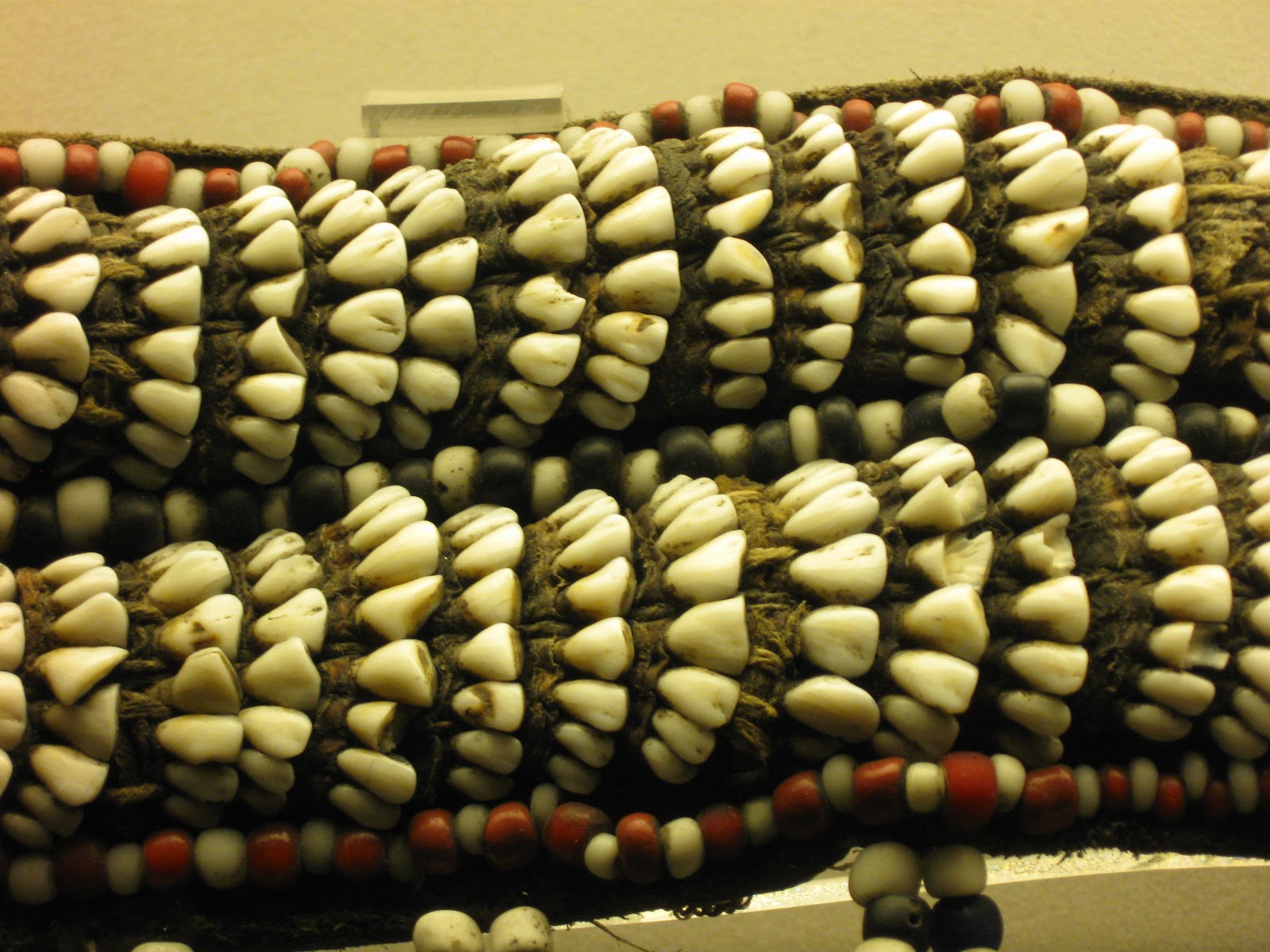
It is a tooth-studded belt made by Alaskan Eskimos. Let's have a close-up:
Most everything else was cool, which is why I will save it all for another post. I do have two last creepy things to share before I go, however. This actually goes beyond creepy and, in my opinion, beyond horrible:
This is an orange flavored HotLix "with cricket." Second ingredient: "cricket." Why would you buy this? Why would you sell this? Why would you make this? These are the questions we asked ourselves, except for Matt, who has apparently always wanted to eat a chocolate-covered grasshopper. The second creepy thing is of course Matt:
This was a temporary exhibit. Nobody knows of what.
Curiously, what I remember finding genuinely creepy in the RMSC did not creep me out at all this time. The local history section is full of life-sized figures set up as if they are going about their day. A lady is buying something at the general store; a dentist is yanking a boy's tooth, much to his distress; Hiram Sibley is sitting in his telegraph office growing an ill-advised beard. There is nothing creepy about it, which makes me wonder why, in my memory, this exhibit is completely different. I remember wandering through a large, deserted room at the end of a long hallway -- not unlike being on the fourth floor of that Chucky museum -- and passing by all these caged figures, who would move in the corner of your eye. Then again, I also remember them being mannequins, which they clearly were not. I'm beginning to think I prefer museums to be creepy, and will create creepiness when I find it lacking in reality.
That having been said, there were several witnesses to the fact that if you shut yourself in the closet of the Underground Railroad cabin, you could hear a telltale heart thudding all around you. RMSC: Creepy.
This subsequently became one of my favorite memories of Edinburgh. There's nothing like being scared to death by dolls whilst alone in a foreign country! Except for being scared to death by life-sized human replicas in your local science museum when you are a young child! Actually, I don't ever remember being scared to death in the RMSC, but the creepiness-potential is very high there. Whenever you combine low lights, a low budget, and the smell of old stuff in a bizarre, rambling structure, you have the ideal conditions for creepiness. Some things are outright creepy, like ceremonial masks with four-foot-long noses, and some things possess a more subtle creepiness that accumulates with time: simply the age of certain exhibits creep me out because they are clearly old, and since I remember them from when I was quite young, I can only conclude that I am aging.
Then there are some things that are just inexplicable, like the amount of taxidermy. My friends and I were forced to assume that the driving force behind the founding of this museum was the necessity of housing someone's taxidermy collection. All the exhibits incorporate taxidermy whether or not it is entirely appropriate. The natural history section? Fine. The brief display on hunting in the Native American section? Smacks of "What shall we do with this extra beaver?" but tolerably logical. The raccoon in the rafters in the Underground Railroad cabin? Someone was definitely trying to stow that sucker where no one would notice. And then there are the squirrels. Oh, the squirrels.
This squirrel lives in the tundra. It is being hunted by a pack of the slavering zombie musk oxen that were prevalent in these parts following the last ice age.
This squirrel lives in a northern hardwood forest. It has been here for eight thousand years. It has spent this period evolving a second sense for popping out of garbage cans just as you are passing by, to make you jump. It has also evolved the ability to laugh at you silently.
This squirrel lives in an orange box, where it is ALWAYS WATCHING.
Were there other animals, you ask? Why, yes; the RMSC is a veritable zoo of death! Among my favorites, there is this beaver
who looks as though he would happily invite you over for a spot of tea and a nibble of something because he is feeling a bit eleven o'clockish, and by the way have you seen Mrs. Tiggywinkle yet today only his waistcoat needs starching before dear old Toad gives his soiree this evening. In all sincerity, I really don't believe beavers were anatomically intended to lean in quite that way, as if they are having a chat with the neighbor.
Then there is this lovely specimen, whom I accused of having no beak, but in fact they all look like this; their beak is sort of hidden in their feathers. What you may think is its beak is a twig in the background. To all appearances it really is beakless, which is quite unsettling.
Oh, I just realized we are supposed to be playing a game. Squirrels: creepy, creepy, creepy. Beaver: more hinky than creepy. Parrot: creepy. Underwater organisims?
Totally cool. However, assortment of old shoes in the local history section?
Creepy. Old shoes come in a close second after two-hundred year old dolls on the scale of creepy things. When they are two-hundred-year-old children's shoes, they're tied. (HAHAHAHA.)
The Native American exhibit is creepy because of its uncanny familiarity, like all things that surface from way, way back in the mists of your childhood. This is a replica of Tadodaho, Onondaga chieftan, who was physically twisted and had crazy hair, and was believed by his people to be a sorcerer. He stood in the way of Hiawatha's attempts to negotiate peace between all the Iroquois tribes; every time Hiawatha held a council, one of his daughters died. Eventually, Hiawatha combed the snakes out of Tadodaho's hair and untwisted his body, and he became a great leader. The leader of the six nations of the Iroquois is still called Tadodaho.
Exhibit: creepy through no fault of its own. Tadodaho: cool.
You may think the next one deserves to be categorized as creepy, but that would be a mistake. It is undoubtedly cool.
It is a tooth-studded belt made by Alaskan Eskimos. Let's have a close-up:
Before we jump to any horrified conclusions, I'm pretty sure these are baby teeth. But they must be the baby teeth of the entire community collected over many years, because it is a rather long belt.
Most everything else was cool, which is why I will save it all for another post. I do have two last creepy things to share before I go, however. This actually goes beyond creepy and, in my opinion, beyond horrible:
This is an orange flavored HotLix "with cricket." Second ingredient: "cricket." Why would you buy this? Why would you sell this? Why would you make this? These are the questions we asked ourselves, except for Matt, who has apparently always wanted to eat a chocolate-covered grasshopper. The second creepy thing is of course Matt:
This was a temporary exhibit. Nobody knows of what.
Curiously, what I remember finding genuinely creepy in the RMSC did not creep me out at all this time. The local history section is full of life-sized figures set up as if they are going about their day. A lady is buying something at the general store; a dentist is yanking a boy's tooth, much to his distress; Hiram Sibley is sitting in his telegraph office growing an ill-advised beard. There is nothing creepy about it, which makes me wonder why, in my memory, this exhibit is completely different. I remember wandering through a large, deserted room at the end of a long hallway -- not unlike being on the fourth floor of that Chucky museum -- and passing by all these caged figures, who would move in the corner of your eye. Then again, I also remember them being mannequins, which they clearly were not. I'm beginning to think I prefer museums to be creepy, and will create creepiness when I find it lacking in reality.
That having been said, there were several witnesses to the fact that if you shut yourself in the closet of the Underground Railroad cabin, you could hear a telltale heart thudding all around you. RMSC: Creepy.
Saturday, May 14, 2011
Sakura
One thing I have not yet figured out how to fix on this stupid blog is making pictures fit the width of the main text. These are being cut off on the right. But they look dumb when they're smaller. I'll have to work on that. In the meantime, if you like cherry blossoms, click on the images to see them in their natural (large) state.
These cherry trees line the quad that I walk through on the way to the library. They're blooming late this year and are just in time for graduation, which would be lovely if it weren't almost guaranteed to pour that day. Every time I get near a graduation, it rains. Sorry, kids.
Monday, May 09, 2011
I never liked ants on a log, but I have all this leftover celery.
Fun facts:
1. This is not horrible if your ant-to-log ratio is somewhere around 370:1.
2. After you eat this, you will hear Raffi singing in your head.
Saturday, May 07, 2011
Is it just me or do the hedgehogs look Vulcan?
I have put up a new header for spring, since it has finally arrived on the east coast (more or less). If this were an accurate depiction of this spring, it would just be blue. For water. Because we have been having some kind of freak monsoon. That certainly would have been easier. You would think by now I could draw a hedgehog. They have a simple shape and all you really need to recognize one is its little upturned nose. But I had a dreadful time creating anything that didn't look like an ROUS. And now when I look at it, I realize I got the ears wrong somehow. Perhaps I should add in a tag line about living long and prospering. At least they lean towards Vulcan and not Ferengi.
Thursday, May 05, 2011
Kristin Lavransdatter and A Novel Bookstore
As I mentioned a few months ago, I have been making a special effort to read more translations. I recently finished two, A Novel Bookstore (which is French) and Kristin Lavransdatter (which is Norwegian). Both, coincidentally, came to me by way of my grandmother, who has good taste.
Kristin Lavransdatter takes place in Norway at the end of the thirteenth century, and follows the rather checkered life of Kristin Daughter-of-Lavrans. I can't be much more specific because it covers her entire lifetime and the plot is a bit diffuse. It is remarkable in many ways, of which I shall pick three and sum up:
1. It is the most lifelike account of life that I've ever read. There are no ridiculous coincidences, laughable plot twists, or miraculous saves. It meanders along just like life does, and sometimes things happen and sometimes they don't. The characters are consistent even as they evolve, and their behavior is utterly believable.
2. It is the most historically accurate book I've ever read. Or so I strongly believe; I am not an expert in medieval Norway so I can't swear to it, but it seems awfully well-researched. I was also extremely impressed by Undset's representation of the medieval mind. The difference between Sigrid Undset and other historical fiction writers like, oh, I don't know, let's say Dorothy Dunnett, is that Undset's characters definitely have never heard of Freud, and Dunnett's have. Obviously they make no overt reference to him, but their awareness of their own psychology is, I think, very modern. It is very difficult to put yourself in a historical mind, and Undset did it without ever faltering.
3. It won Sigrid Undset a Nobel Prize, in spite of the fact that she is a woman and it is entirely about a woman. These days, if you write fiction about a woman, and she has a family, it is called "domestic" and you can expect very little attention even if you are very good -- if you're a woman yourself. When men do it, it's "insightful." So I was pleased that in 1928, the Nobel Committee was wise enough to recognize that it is not just a technical masterpiece, but an important story. I would have said the odds of that happening were very long. But that is what an accomplishment it is.
The other book is A Novel Bookstore which could not be more different. It is a much lighter and shorter read, with a more focused plot. It's about a group of people who love good novels so much they decide to open a bookstore that only stocks books they deem to be "good." There is a vicious backlash from a surprisingly large number of people who find this to be unacceptable snobbery, including publishers, other booksellers, newspapers, and writers whose books were not chosen to be in the store. Basically, this book agrees with everything I have ever thought about the book-publishing and book-selling business, so I 100% loved it. Also, it was very satisfying to be in a world where good books are a life-or-death issue.
The best parts of the book are about the logistics of setting up the bookstore. That may sound boring, but it was like being in on the thought process during the creation of the best bookstore that could ever be imagined. Needless to say, I was enthralled. My favorite part is one character's manifesto about the importance of good books:
"We have no time to waste on insignificant books, hollow books, books that are here to please.
"We have no time for those sloppy, hurried books of the 'Go on, I need it for July, and in September we'll give you a proper launch and sell one hundred thousand copies, it's in the bag' variety.
"We want books that are written for those of us who doubt everything, who cry over the least little thing, who are startled by the slightest noise.
"We want books that cost their authors a great deal, books where you can feel the years of work, the backache, the writer's block, the author's panic at the thought that he might be lost: his discouragement, his courage, his anguish, his stubbornness, the risk of failure he has taken.
"We want splendid books, books that immerse us in the splendor of reality and keep us there; books that prove to us that love is at work in the world next to evil, right up against it, at times indistinctly, and that it always will be, just the way that suffering will always ravage hearts. We want good novels."
We also want more translations.
Kristin Lavransdatter takes place in Norway at the end of the thirteenth century, and follows the rather checkered life of Kristin Daughter-of-Lavrans. I can't be much more specific because it covers her entire lifetime and the plot is a bit diffuse. It is remarkable in many ways, of which I shall pick three and sum up:
1. It is the most lifelike account of life that I've ever read. There are no ridiculous coincidences, laughable plot twists, or miraculous saves. It meanders along just like life does, and sometimes things happen and sometimes they don't. The characters are consistent even as they evolve, and their behavior is utterly believable.
2. It is the most historically accurate book I've ever read. Or so I strongly believe; I am not an expert in medieval Norway so I can't swear to it, but it seems awfully well-researched. I was also extremely impressed by Undset's representation of the medieval mind. The difference between Sigrid Undset and other historical fiction writers like, oh, I don't know, let's say Dorothy Dunnett, is that Undset's characters definitely have never heard of Freud, and Dunnett's have. Obviously they make no overt reference to him, but their awareness of their own psychology is, I think, very modern. It is very difficult to put yourself in a historical mind, and Undset did it without ever faltering.
3. It won Sigrid Undset a Nobel Prize, in spite of the fact that she is a woman and it is entirely about a woman. These days, if you write fiction about a woman, and she has a family, it is called "domestic" and you can expect very little attention even if you are very good -- if you're a woman yourself. When men do it, it's "insightful." So I was pleased that in 1928, the Nobel Committee was wise enough to recognize that it is not just a technical masterpiece, but an important story. I would have said the odds of that happening were very long. But that is what an accomplishment it is.
The other book is A Novel Bookstore which could not be more different. It is a much lighter and shorter read, with a more focused plot. It's about a group of people who love good novels so much they decide to open a bookstore that only stocks books they deem to be "good." There is a vicious backlash from a surprisingly large number of people who find this to be unacceptable snobbery, including publishers, other booksellers, newspapers, and writers whose books were not chosen to be in the store. Basically, this book agrees with everything I have ever thought about the book-publishing and book-selling business, so I 100% loved it. Also, it was very satisfying to be in a world where good books are a life-or-death issue.
The best parts of the book are about the logistics of setting up the bookstore. That may sound boring, but it was like being in on the thought process during the creation of the best bookstore that could ever be imagined. Needless to say, I was enthralled. My favorite part is one character's manifesto about the importance of good books:
"We have no time to waste on insignificant books, hollow books, books that are here to please.
"We have no time for those sloppy, hurried books of the 'Go on, I need it for July, and in September we'll give you a proper launch and sell one hundred thousand copies, it's in the bag' variety.
"We want books that are written for those of us who doubt everything, who cry over the least little thing, who are startled by the slightest noise.
"We want books that cost their authors a great deal, books where you can feel the years of work, the backache, the writer's block, the author's panic at the thought that he might be lost: his discouragement, his courage, his anguish, his stubbornness, the risk of failure he has taken.
"We want splendid books, books that immerse us in the splendor of reality and keep us there; books that prove to us that love is at work in the world next to evil, right up against it, at times indistinctly, and that it always will be, just the way that suffering will always ravage hearts. We want good novels."
We also want more translations.
Thursday, April 28, 2011
Computer Security Idea
Reverse the buttons on your mouse and put it on the left side of your computer. This will baffle everyone including lefties who, forced by a cruel world to adapt, use their mouse as if they were right-handed.
What I would like to see is a spy movie in which the hero gets through all the high-tech security only to find out that the villain is left-handed, and instead of being worried about the speed with which the Very Important Information can be downloaded, the suspense could be about the hero trying to figure out how to use the mouse in time to even GET to the downloading part.
Or maybe beforehand there could be a montage of the hero training by playing Minesweeper with a left-handed mouse. I can tell you from experience that it's surprisingly suspenseful.
This movie would be uproarious to 10-13% of the population. Any Hollywood producers who would like to option this blog post, please comment.
What I would like to see is a spy movie in which the hero gets through all the high-tech security only to find out that the villain is left-handed, and instead of being worried about the speed with which the Very Important Information can be downloaded, the suspense could be about the hero trying to figure out how to use the mouse in time to even GET to the downloading part.
Or maybe beforehand there could be a montage of the hero training by playing Minesweeper with a left-handed mouse. I can tell you from experience that it's surprisingly suspenseful.
This movie would be uproarious to 10-13% of the population. Any Hollywood producers who would like to option this blog post, please comment.
Friday, April 22, 2011
Illustrative Moment of Workplace Priorities
Coworker passes cubicle carrying two paper plates of food in each hand. Calls out, "There's food in the HC Room!"
Three other coworkers instantly pass in the other direction, giggling.
Thirty seconds later I get an e-mail from another coworker, who is not even at her desk, alerting us all to the exciting news about free food.
Three other coworkers instantly pass in the other direction, giggling.
Thirty seconds later I get an e-mail from another coworker, who is not even at her desk, alerting us all to the exciting news about free food.
Friday, April 01, 2011
An excuse to talk about Beowulf!
It's pretty impressive that Anglo-Saxon poetry gets as much attention as it does, considering that only about 30,000 lines of it exist. (That sounds quite respectable until you compare it with ancient Greek poetry: The Iliad and the Odyssey together are about 27,000 lines, and there's a lot more besides.) It also has against it the fact that some of that poetry is really bad religious poetry. Some of it is nice, good, vibrant religious poetry, and some of it is complete drivel, the equivalent of unoriginal poetry about springtime. And last but not least, it is in a form that somehow managed not to evolve at all for like five hundred years, which makes it look like a loser in the literary scheme of things.
Oh, and it's alliterative, which Chaucer thought was lame.
Therefore, when someone who is not an academic shows interest in these poems, I am always surprised. And at first delighted. And then annoyed. Because the people who show interest are always poets, and they always manage to say rude things about the academics who did all the heavy lifting that makes it possible for anyone to translate anything at all. For example, there is a new book coming out called The Word Exchange, in which various current poets translate various Old English poems. I think it looks pretty awesome and someday when I have spare money I will almost certainly buy it. But, I did not appreciate what the editor had to say about the book:
"What's so great about this - all Anglo-Saxon poetry has been translated by scholars and academic people. It has generally been very accurate but not always great poetry. They couldn't get that kind of energy into it."
PARDON ME, SIR. This aggravates me in so many ways I need bullet points to address it.
Anyway, because so few people care at all about poetry, much less Anglo-Saxon translations, I really just wanted to point out that academics are probably a reasonably large part of the market for this book and it's probably unwise to give interviews in which you basically refer to them as cultural boors. The end.
Oh, and it's alliterative, which Chaucer thought was lame.
Therefore, when someone who is not an academic shows interest in these poems, I am always surprised. And at first delighted. And then annoyed. Because the people who show interest are always poets, and they always manage to say rude things about the academics who did all the heavy lifting that makes it possible for anyone to translate anything at all. For example, there is a new book coming out called The Word Exchange, in which various current poets translate various Old English poems. I think it looks pretty awesome and someday when I have spare money I will almost certainly buy it. But, I did not appreciate what the editor had to say about the book:
"What's so great about this - all Anglo-Saxon poetry has been translated by scholars and academic people. It has generally been very accurate but not always great poetry. They couldn't get that kind of energy into it."
PARDON ME, SIR. This aggravates me in so many ways I need bullet points to address it.
- It is not a new thing for poets to translate from the Anglo-Saxon. Ezra Pound did it in 1912. Seamus Heaney did it in 1999. A bunch of other people have done it in between. This has been going on fairly steadily for a hundred years.
- It is the express duty of scholars to be accurate. Scholars of Old English are necessarily also historians, and they all have their own interpretations of history, which affect their translations of the poem. They translate the poem to communicate a new interpretation. There is plenty of energy in it, but it's a kind that poets aren't built to recognize or particularly care about.
- It is the express duty of poets to be loosey-goosey, touchy-feely, and artsy-fartsy. If you want extreme violence (referring here to Beowulf) beautifully rendered, you go and read a translation by a poet. If you want extreme violence as expressed by the people who knew about it -- regardless of how they expressed it -- go for the scholar.
- The difference between the translations of poets and scholars is only in their approach. Poets are trying to create a version of the poem that will evoke the same feelings in their modern audience that the original version evoked in the Anglo-Saxon audience. They're interested in the experience of the poem, whereas scholars are interested in the Anglo-Saxons. They want to get as close to the original version as possible, because that's what moved the Anglo-Saxons. It isn't about how you are feeling, it's about how they were feeling, and what in the text made them feel it. If you can get there, you're closer to knowing who they were.
Anyway, because so few people care at all about poetry, much less Anglo-Saxon translations, I really just wanted to point out that academics are probably a reasonably large part of the market for this book and it's probably unwise to give interviews in which you basically refer to them as cultural boors. The end.
Thursday, March 31, 2011
True Story
"Elisha Scudder was crossing the bay in a canoe -- saw a bear swimming -- struck at him -- missed, the axe going out of his hands into the water. The bear, tired of swimming, mounted into the canoe, and remained in it till it reached the shore; stepping out, and marching off deliberately, without even thanking the ferryman."
Monday, March 28, 2011
When I was 12, "don't touch gravel" was considered an exciting game.
While reading over the weekend I came across this intriguing section:
"After school to-night I went out into Abbie Clark's garden with her and she taught me how to play 'mumble te peg.' It is fun, but rather dangerous. I am afraid Grandmother won't give me a knife to play with."
I looked up mumblety-peg and discovered that it is a game wherein two players stand across from each other with their feet apart, and take turns throwing pocket-knives into the ground, aiming to get as near to their own feet as possible. The person who gets the knife closest to his or her foot wins. You can also win by getting the knife IN your foot, but that is not desirable.
Variations on the game involve drinking while playing, which is obviously a terrible idea, and throwing the knife at the other person's foot rather than your own, which if combined with the alcohol variant seems likely to result in serious injury. Throw in trick tosses and we have a recipe for certain death.
The twelve-year-old girl who wrote the section above goes on to say, in the same paragraph: "Abbie Clark has beautiful pansies in her garden and gave me some roots." I gather from this that both players survived the game without incident, but it does leave me in some doubt as to how many children in the past couple hundred years reached adulthood with all ten toes.
"After school to-night I went out into Abbie Clark's garden with her and she taught me how to play 'mumble te peg.' It is fun, but rather dangerous. I am afraid Grandmother won't give me a knife to play with."
I looked up mumblety-peg and discovered that it is a game wherein two players stand across from each other with their feet apart, and take turns throwing pocket-knives into the ground, aiming to get as near to their own feet as possible. The person who gets the knife closest to his or her foot wins. You can also win by getting the knife IN your foot, but that is not desirable.
Variations on the game involve drinking while playing, which is obviously a terrible idea, and throwing the knife at the other person's foot rather than your own, which if combined with the alcohol variant seems likely to result in serious injury. Throw in trick tosses and we have a recipe for certain death.
The twelve-year-old girl who wrote the section above goes on to say, in the same paragraph: "Abbie Clark has beautiful pansies in her garden and gave me some roots." I gather from this that both players survived the game without incident, but it does leave me in some doubt as to how many children in the past couple hundred years reached adulthood with all ten toes.
Friday, March 25, 2011
Wednesday, March 23, 2011
Another sequence of events concerning salt.
1. I get up at an ungodly hour for an appointment the cardiologist made me make several weeks ago.
2. Doctor tells me I am totally fine, but I should lie down quickly in certain cases of nausea, pain, or grossitude, or I will probably faint.
3. I wonder why I got up at an ungodly hour, drove fifteen miles, and paid twenty dollars for a six-minute appointment in which I am being told something I have already learned through trial and error.
4. Doctor adds that I can have "all the salt in the world" including "pretzels, chips, whatever, load it on!"
5. I feel immensely satisfied with life, having just been issued a medical imperative to incorporate Cheetos to my daily diet.
6. I wonder what condition I can develop in order to be told that I am also required to ingest all the saturated fat and hydrogenated oil in the world, because otherwise I really only get to lick the salt off the Cheetos, not eat them.
7. I am sad.
2. Doctor tells me I am totally fine, but I should lie down quickly in certain cases of nausea, pain, or grossitude, or I will probably faint.
3. I wonder why I got up at an ungodly hour, drove fifteen miles, and paid twenty dollars for a six-minute appointment in which I am being told something I have already learned through trial and error.
4. Doctor adds that I can have "all the salt in the world" including "pretzels, chips, whatever, load it on!"
5. I feel immensely satisfied with life, having just been issued a medical imperative to incorporate Cheetos to my daily diet.
6. I wonder what condition I can develop in order to be told that I am also required to ingest all the saturated fat and hydrogenated oil in the world, because otherwise I really only get to lick the salt off the Cheetos, not eat them.
7. I am sad.
Monday, March 21, 2011
Thank you, great giver of alpacas!
On Saturdays, the post office closes at noon, but the building stays open until three, so you can still check your mail if you are very lazy and have not showered by noon, not that that has ever been an issue for me, no sir. Last weekend I happened to miss noon by about ten minutes, which was distressing as I found a yellow card in my box that said, "You have too much mail." That means I have to go to the window and ask for my mail, like it's 1902 and I'm Anne of Green Gables. Sometimes this card means something exciting has come, but more often it means Axa has sent me an enormous report that cannot physically fit into my box. The post office is willing to crush or destroy almost anything to get it in the box, but even they cannot make that Axa report small enough. They might as well file it in the recycling bin, because that's what I do before I even leave the building, but I guess it would be illegal if they did it. Anyway, it didn't bother me much that I was missing out on an Axa report -- until I remembered that I told Axa to start sending them to me electronically. Which means the yellow card indicated that there was a chance, albeit low, of something interesting having come.
This part of the story actually has no bearing on the rest of it, but I felt it needed a bit of suspense at the beginning, so that you could experience, in miniature, the day and a half that I spent thinking, "WHAT IS IT?" and therefore see why it was so funny when I finally found out what it was. When I returned on Monay I was still mostly expecting some enormous nuisance from one of the many organizations that exist to plague me. What I got was this:
I appear to have been mysteriously subscribed to Alpacas Magazine. That, or I hit the best jackpot ever. Which is the jackpot that randomly sends people camelid-related periodicals. Now that I think about this, there should be a lottery that is not about money, but is about completely unexpected things happening at unexpected times. They would be good things, obviously. Things like, you buy a ticket, and six months later a stranger mails you a postcard from Brazil telling you that you are the brightest star. (That will make perfect sense in a minute.) Everyone would win this new surprise-based lottery, and none of them would be tempted to funnel their sudden wealth into a doomed restaurant and lose it all, which apparently is the typical fate of lotto winners.
Anyway. I have been reading this magazine, and so far, one thing I've learned is that the advertising of the alpaca-breeding world trumps all other advertising I've ever seen. For example:
First thought: "That's not Sirius Black!" Second thought: "Actually, Sirius Black was an Animagus, so maybe it could be Sirius Black!" Third thought: "This ad couldn't be any weirder." But I was wrong. Behold the inside:
My loyal friend Simon P. and I have a tradition of trading headlines that we have misread. Recently I sent her the headline "Heavy Rains Linked to Humans." I had misread it as "Heavy Rains Linked to Hamas," which led me to believe for a moment that Hamas had genuinely impressive powers. She wrote back and said, "I misread your Hamas as Llamas." I don't know if that would be impressive for llamas or not. They do spit, after all, if you want to consider that rain. But the point is that I sometimes fall victim to little reading errors. When I read the right-hand side of this ad, for some reason I read it as "Satan King," and I must tell you I was very confused as to why the Satanic alpaca was being depicted among puffy clouds with a heavenly light shooting out of its head. Even now I am not entirely sure what's happening in this ad, but it's sort of a masterpiece if you ask me.
Now that I've got that important advertising analysis out of the way, I should say this is actually a terribly interesting magazine that many people could benefit from. There's this one article on alpaca behavior in which someone complains to the author that his alpaca spits. He believes it is simply the nature of this alpaca to spit. If this alpaca existed in a neutral vacuum, the gosh-darned creature would still spit. The author asks him, nonchalantly, what he is doing when the alpaca spits. He says he is picking nits out of its fur. She says, "Stop doing that." I really think the lesson here also applies to humans. No one is born a spitter. So to speak.
There's also an entire article on how to take good pictures of alpacas that is really about how to take good pictures, period. And, to my delight, it ends with an explanation of why you should never send a designer an image that is 72 dpi and expect it to print well on paper. Seriously, alpaca-photographers, non-alpaca photographers, and, to cover all our bases, photographers who may or may not be alpacas. Don't do this. It makes your designer spit.
I'm almost done here, but there are a couple more things. First, did you know there was such a thing as Berserk Male Syndrome? Yes, of course you did, because you remember college. But that's not what I mean. Evidently if you hang out with a baby alpaca too much, the baby starts to think people are alpacas too, and then when they're adults, they start feeling that they need to defend their territory from you. Apparently this is quite dangerous, and the condition is incurable, and generally they end up being euthanized. Fortunately it is rather rare. Usually when alpacas are mean, it's because you're picking nits out of them or giving them images that are 72 dpi. Anyway, it's a great name for a syndrome. Flexible usage.
Second, aside from the holy alpacas above, there is some great marketing in here. Take this tagline for example: "When roses aren't enough for your girl... try Rosehaven Alpacas!" While there are relatively few circumstances under which is it practical to bestow a bouquet of alpacas on someone, I love this idea both figuratively and literally.
And third, this:
This part of the story actually has no bearing on the rest of it, but I felt it needed a bit of suspense at the beginning, so that you could experience, in miniature, the day and a half that I spent thinking, "WHAT IS IT?" and therefore see why it was so funny when I finally found out what it was. When I returned on Monay I was still mostly expecting some enormous nuisance from one of the many organizations that exist to plague me. What I got was this:
I appear to have been mysteriously subscribed to Alpacas Magazine. That, or I hit the best jackpot ever. Which is the jackpot that randomly sends people camelid-related periodicals. Now that I think about this, there should be a lottery that is not about money, but is about completely unexpected things happening at unexpected times. They would be good things, obviously. Things like, you buy a ticket, and six months later a stranger mails you a postcard from Brazil telling you that you are the brightest star. (That will make perfect sense in a minute.) Everyone would win this new surprise-based lottery, and none of them would be tempted to funnel their sudden wealth into a doomed restaurant and lose it all, which apparently is the typical fate of lotto winners.
Anyway. I have been reading this magazine, and so far, one thing I've learned is that the advertising of the alpaca-breeding world trumps all other advertising I've ever seen. For example:
First thought: "That's not Sirius Black!" Second thought: "Actually, Sirius Black was an Animagus, so maybe it could be Sirius Black!" Third thought: "This ad couldn't be any weirder." But I was wrong. Behold the inside:
My loyal friend Simon P. and I have a tradition of trading headlines that we have misread. Recently I sent her the headline "Heavy Rains Linked to Humans." I had misread it as "Heavy Rains Linked to Hamas," which led me to believe for a moment that Hamas had genuinely impressive powers. She wrote back and said, "I misread your Hamas as Llamas." I don't know if that would be impressive for llamas or not. They do spit, after all, if you want to consider that rain. But the point is that I sometimes fall victim to little reading errors. When I read the right-hand side of this ad, for some reason I read it as "Satan King," and I must tell you I was very confused as to why the Satanic alpaca was being depicted among puffy clouds with a heavenly light shooting out of its head. Even now I am not entirely sure what's happening in this ad, but it's sort of a masterpiece if you ask me.
Now that I've got that important advertising analysis out of the way, I should say this is actually a terribly interesting magazine that many people could benefit from. There's this one article on alpaca behavior in which someone complains to the author that his alpaca spits. He believes it is simply the nature of this alpaca to spit. If this alpaca existed in a neutral vacuum, the gosh-darned creature would still spit. The author asks him, nonchalantly, what he is doing when the alpaca spits. He says he is picking nits out of its fur. She says, "Stop doing that." I really think the lesson here also applies to humans. No one is born a spitter. So to speak.
There's also an entire article on how to take good pictures of alpacas that is really about how to take good pictures, period. And, to my delight, it ends with an explanation of why you should never send a designer an image that is 72 dpi and expect it to print well on paper. Seriously, alpaca-photographers, non-alpaca photographers, and, to cover all our bases, photographers who may or may not be alpacas. Don't do this. It makes your designer spit.
I'm almost done here, but there are a couple more things. First, did you know there was such a thing as Berserk Male Syndrome? Yes, of course you did, because you remember college. But that's not what I mean. Evidently if you hang out with a baby alpaca too much, the baby starts to think people are alpacas too, and then when they're adults, they start feeling that they need to defend their territory from you. Apparently this is quite dangerous, and the condition is incurable, and generally they end up being euthanized. Fortunately it is rather rare. Usually when alpacas are mean, it's because you're picking nits out of them or giving them images that are 72 dpi. Anyway, it's a great name for a syndrome. Flexible usage.
Second, aside from the holy alpacas above, there is some great marketing in here. Take this tagline for example: "When roses aren't enough for your girl... try Rosehaven Alpacas!" While there are relatively few circumstances under which is it practical to bestow a bouquet of alpacas on someone, I love this idea both figuratively and literally.
And third, this:
Jackpot.
Monday, March 14, 2011
And stop sending me junk mail!
Ring, ring.
Simon: Hello?
Dude: Hi Simon, this is so-and-so from Distinguished Academic Press. I'm calling about your resume.
Simon: Okay.
Dude: Now, this position is in Manhattan. I understand you live outside of Manhattan?
Simon: laughs
Silence.
Simon realizes Dude actually has no clue where anything is located north of Yonkers. For all he knows, dragons live there, in the hinterlands.
Simon: Yes. Several hours outside of Manhattan.
Dude: Oh. Really? Wow. Well, we'll call you for a phone interview if we don't fill this position with people we can bring in directly.
Simon: Thank you so much. Goodbye.
All I can think is, surely this press has published an atlas he could look at sometime?
Simon: Hello?
Dude: Hi Simon, this is so-and-so from Distinguished Academic Press. I'm calling about your resume.
Simon: Okay.
Dude: Now, this position is in Manhattan. I understand you live outside of Manhattan?
Simon: laughs
Silence.
Simon realizes Dude actually has no clue where anything is located north of Yonkers. For all he knows, dragons live there, in the hinterlands.
Simon: Yes. Several hours outside of Manhattan.
Dude: Oh. Really? Wow. Well, we'll call you for a phone interview if we don't fill this position with people we can bring in directly.
Simon: Thank you so much. Goodbye.
All I can think is, surely this press has published an atlas he could look at sometime?
Friday, February 25, 2011
Thursday, February 17, 2011
Statistics
Recently, VIDA published a set of statistics that makes it horrifyingly clear how underrepresented women are in book reviews and as book reviewers. Everyone who has anything to do with book reviewing right now probably wants to hide under their desk; it's very embarrassing. For example, The New York Review of Books had 239 book reviewers last year, and 200 of them were men. It published 365 reviews, and only 59 of them were of books by women. These numbers are not just a little hinky, they are wildly insane. And they're very similar across the vast majority of book-reviewing publications.
This subject came up a few months ago and I wrote about it then, wondering whether there simply are more books by men, and if so, why? Apparently men do get published more readily (surprise), and the anecdotal concensus is that it's because women don't submit as much work. The anecdotal logic behind the anecdotal concensus is that women are not as aggressive, are more easily discouraged by rejection, or are probably too busy, you know, doing laundry. There's also a whole thing about the perception of what constitutes "real" literature, as in, if it's about lady-problems, or even just from a lady-perspective, maybe it doesn't really matter universally in the way that books by or about men do. Which is a can of worms that makes me too angry to write about coherently so I'll save that for later.
Anyway, I thought before I started criticizing book review editors' decisions, I should look at what I read over the past year and see whether my completely random reading habits led me down the evil path of accidental sexism. AND THEY DID. Mostly. Facts (not scientific):
This subject came up a few months ago and I wrote about it then, wondering whether there simply are more books by men, and if so, why? Apparently men do get published more readily (surprise), and the anecdotal concensus is that it's because women don't submit as much work. The anecdotal logic behind the anecdotal concensus is that women are not as aggressive, are more easily discouraged by rejection, or are probably too busy, you know, doing laundry. There's also a whole thing about the perception of what constitutes "real" literature, as in, if it's about lady-problems, or even just from a lady-perspective, maybe it doesn't really matter universally in the way that books by or about men do. Which is a can of worms that makes me too angry to write about coherently so I'll save that for later.
Anyway, I thought before I started criticizing book review editors' decisions, I should look at what I read over the past year and see whether my completely random reading habits led me down the evil path of accidental sexism. AND THEY DID. Mostly. Facts (not scientific):
- Of the 47 books I read in the past twelve months, only 18 were by women, which is 38%. Since women make up roughly 25% of published authors (last year, anyway), I'm doing better than average. Especially considering that I was making no particular effort to read women.
- However, I was making a particular effort to read more translations, and I managed to read 13 of those, or 28%. Translated fiction makes up less than 1% of work published in the US annually. So the fact that I read that pathetically low percentage of women while reading that ridiculously high percentage of translations suggests to me that I should pay more attention.
- But back to the point: Of the 7 authors by whom I read more than one book, 4 were women. (A. S. Byatt, Zadie Smith, Isak Dinesen/Karen Blixen, Sigrid Undset.) But, one was a trilogy, so I don't know if that counts.
- Of the books that stand out as being the best writing, 3 were by women, and 3 were by men. (These were, incidentally, Byatt's Little Black Book of Stories, Heller's Catch-22, Dinesen's Out of Africa, Sayers's Gaudy Night, Gavelis's Vilnius Poker, and Cunningham's The Hours -- I recommend them all except maybe Vilnius Poker, which has to be the most harrowing masterpiece I've ever read.)
- Women were more likely to have male main characters than men were to have female main characters. (Michael Cunningham was the sole male author with a female main character -- three, in fact -- although David Mitchell had a pretty awesome female ensemble character in The Thousand Autumns of Jacob de Zoet who carried the narrative for a while.)
- Women were also more likely to have developed male characters in their ensemble cast than men were to have developed female characters in theirs.
- Men were 100% more likely to talk about genitals. Men were also 100% more likely to write scenes in which women throw themselves at the main character, to the point that it stretched the limits of my credulity. This was particularly true of translated fiction for some reason, but I'm limiting my generalizations today to men and women; perhaps I will generalize about Europeans and South Americans in another post.
- On a non-gender-related note, in the past year I've read nothing published earlier than 1920. It is very odd for me to go an entire year without reading a Victorian novel. I had better go read some Brontës lest I forget how to use words like "lest." (I had to go back and change to "Brontës" from "Dickens." You see, you see how it gets in your head that men are the standard? AAAAAUGH.)
Tuesday, February 15, 2011
If Hemingway Had a Pizza Place
Hemingway's Green Hills of Africa is the memoir of a 1933 safari he went on with his wife (the second of four). In it he describes how he mostly fails to shoot anything good, and if he succeeds, someone else gets a better specimen and he gets jealous for a while and then he has a drink in the evening and shakes hands with the other fellow and balance in the universe is temporarily restored. Variations on this theme are brought to a close when he at last proves to himself that he is, indeed, a superior shot. Maybe the best shot ever to have lived. Maybe the best shot ever to live. Hemingway then satisifed that he is the manliest of all men, all is right with the world, and the book ends.
I exaggerate because there is nothing else you can do with Hemingway but mock him and secretly resent that he actually is kind of better than everyone else, his personal problems notwithstanding. Anyway, here's a brief brief exerpt, concerning the long-awaited shooting of a kudu:
"The Wanderobo-Masai and I looked at this kudu, measured his horns, smelled the fine smell of him, sweeter than an eland, even, stroked his nose, his neck, and his shoulder, marvelling at the great ears, and the smoothness and cleanness of his hide, looked at his hooves, that were built long, narrow, and springy so he seemed to walk on tip-toe, felt under his shoulder for the bullet-hole and then shook hands again while the Wanderobo-Masai told what a man he was and I told him he was my pal and gave him my best four-bladed pocket knife."
Not being up on the particulars of African ungulates, I went through the book picturing everything as an antelope because I figured that was roughly accurate for whatever Hemingway was hunting at any given time. I meant to look up kudus and elands after I finished the book but I forgot.
Skip head a few months to this conversation with my sister, enhanced for comic effect.
Sister: We could get pizza for dinner.
Me: Is there a good pizza place near you?
Sister: Well, there's the place up the street. I don't know if it's good, but it's fine.
Me: Hmmm.
Sister: It has animal heads mounted on the walls.
Me: SOLD.
Thinking of a potential blog post, and hoping very much for kudu, I brought my camera and subjected my sister to the humiliation of loitering around while I took not-terribly-discreet pictures. I honestly can't imagine they're not used to people taking pictures inside a pizza place that is full of taxidermied wildlife, but it was still totally weird of me. Yet, so worth it. This hunter-slash-pizza-parlor-entrepreneur had definitely been to Africa and pretty much shot everything in sight, examples below.
I'm not wild about hunting for sport, buuuuut there is something so extremely weird about this pizza-by-Hemingway atmosphere that it very nearly crosses the line into "delightful." It could only be better if these were the decorations in, say, a restaurant with an entirely vegetarian menu.
If you live nearby and these photos do not convince you to find this place and go there, I will add that the pizza is pretty good, too. However, I firmly believe it would be worth a trip either way. This decor is rather rare. As, I now suspect, are caribou.
I exaggerate because there is nothing else you can do with Hemingway but mock him and secretly resent that he actually is kind of better than everyone else, his personal problems notwithstanding. Anyway, here's a brief brief exerpt, concerning the long-awaited shooting of a kudu:
"The Wanderobo-Masai and I looked at this kudu, measured his horns, smelled the fine smell of him, sweeter than an eland, even, stroked his nose, his neck, and his shoulder, marvelling at the great ears, and the smoothness and cleanness of his hide, looked at his hooves, that were built long, narrow, and springy so he seemed to walk on tip-toe, felt under his shoulder for the bullet-hole and then shook hands again while the Wanderobo-Masai told what a man he was and I told him he was my pal and gave him my best four-bladed pocket knife."
Not being up on the particulars of African ungulates, I went through the book picturing everything as an antelope because I figured that was roughly accurate for whatever Hemingway was hunting at any given time. I meant to look up kudus and elands after I finished the book but I forgot.
Skip head a few months to this conversation with my sister, enhanced for comic effect.
Sister: We could get pizza for dinner.
Me: Is there a good pizza place near you?
Sister: Well, there's the place up the street. I don't know if it's good, but it's fine.
Me: Hmmm.
Sister: It has animal heads mounted on the walls.
Me: SOLD.
Thinking of a potential blog post, and hoping very much for kudu, I brought my camera and subjected my sister to the humiliation of loitering around while I took not-terribly-discreet pictures. I honestly can't imagine they're not used to people taking pictures inside a pizza place that is full of taxidermied wildlife, but it was still totally weird of me. Yet, so worth it. This hunter-slash-pizza-parlor-entrepreneur had definitely been to Africa and pretty much shot everything in sight, examples below.
| Lion (clearly) |
| Eland, brown bear (brown bear obviously not African) |
| African buffalo (maybe), a trio of impala in the corner, another impala over the lamp, and an oryx (with the very long horns) |
| Caribou, (zebra on the other side), caribou, (kudu on the other side), caribou, (ice cream cone on the other side), wildebeest |
If you live nearby and these photos do not convince you to find this place and go there, I will add that the pizza is pretty good, too. However, I firmly believe it would be worth a trip either way. This decor is rather rare. As, I now suspect, are caribou.
Thursday, February 03, 2011
Dogsled Racing at Mendon Ponds
A couple of weeks ago I went with some pals to see the dogsled races at this year's Winter Fest. It was extremely cold and I was too concerned about losing toes to frostbite to take very good pictures. Also, dogs are fast and my camera is slow. Especially in the cold.
These people came with six dogs and hooked them up to this chain one by one. I have a terribly cute picture of them adoring a little girl, but one can't just go around posting pictures of people's kids on the Internet, so you don't get to see it. It is super cute, though. They were very friendly dogs.
Apparently there is this thing where you attach dogs to yourself while you're on skis, and they pull you. It is very strange, but it looks like fun. These dogs started off at a leisurely trot, as if to communicate to everyone present, "We were not bred for this, but we have been promised treats at the finish line."
These people came with six dogs and hooked them up to this chain one by one. I have a terribly cute picture of them adoring a little girl, but one can't just go around posting pictures of people's kids on the Internet, so you don't get to see it. It is super cute, though. They were very friendly dogs.
Apparently there is this thing where you attach dogs to yourself while you're on skis, and they pull you. It is very strange, but it looks like fun. These dogs started off at a leisurely trot, as if to communicate to everyone present, "We were not bred for this, but we have been promised treats at the finish line."
I was the most surprised to see this handsome fellow racing, as my experience with Golden Retrievers suggest they are not into running flat-out for four-mile stretches. His accompanying skier said that this is the only Golden Retriever he's seen doing this. Usually they're so much more interested in being with humans that they want to wrap themselves around your legs rather than pull you. I bet this one fetches, too. Weirdo.
Here's an actual dogsled. The Huskies (or whatever kind of mix they are) were impressively fast. There were never more than three to a sled, but it would have been cool to see a whole pack racing.
Huskies are very adorable, but they remind me so much of wolves that they make me slightly nervous. It must be some kind of primordial instinct. I will probably stick with Golden Retrievers in the future, even if they aren't star athletes.
After the dogsled racing I came home and threw up a lot. So that day was a mixed bag. But the morning, at least, was pretty awesome.
Wednesday, February 02, 2011
La La Land
It's pretty ridiculous.
Tuesday, February 01, 2011
What to do with extra Fimo.
If you are working on a project and you buy the wrong kind of Fimo and find it next to impossible to sculpt into the shape you want, what you should do is use it to make models of sea slugs. Or, better yet, you should show your friend a picture of a sea slug and demand that he make one for you while you work on something else.
Obviously you would need to have an unusual kind of friend, and you would be need to working in an atmosphere in which the phrase, "Sea slugs happen to be a particular interest of mine," is met with a frankly bizarre level of indulgence.
That should explain, to anyone who sees it, what this rather unique object lying around my house is. It's a homemade Chromodoris magnifica magnet, of course, what else?
Obviously you would need to have an unusual kind of friend, and you would be need to working in an atmosphere in which the phrase, "Sea slugs happen to be a particular interest of mine," is met with a frankly bizarre level of indulgence.
That should explain, to anyone who sees it, what this rather unique object lying around my house is. It's a homemade Chromodoris magnifica magnet, of course, what else?
Friday, January 28, 2011
Sequence of Events
1. Doctor suggests I may not be getting enough salt.
2. I imagine myself being issued a medical imperative to incorporate Cheetos into my daily diet.
3. Doctor recommends drinking some V8.
4. I am sad.
2. I imagine myself being issued a medical imperative to incorporate Cheetos into my daily diet.
3. Doctor recommends drinking some V8.
4. I am sad.
Thursday, January 13, 2011
Inspector Havers
I have been making my way through all of the Inspector Lynley episodes in existence. It occurs to me, as I near the end, that Inspector Lynley is an idiot. The main conflict of the story, at least in the beginning, is that Lynley is an aristocrat who drives a fancy car and appears to do police work just because it's fun and he happens to be okay at it, while his detective sergeant, Barbara Havers is working-class, has a generally bad attitude, and bitterly hates everything about him that is privileged. Here's the thing: Havers is by far the better detective. Lynley is always like, "He can't have murdered anyone, he went to Oxford," or "Yes, I totally pulled strings to get this case because it involves cricket," or "I am too emotionally crippled to focus properly on my job." Meanwhile, Havers is doing all the work, taking all the risks, standing up to everyone, putting all the clues together, and being one hundred percent awesome, all while maintaining an admirable level of snark toward her superiors. If there is one thing I wish we could have seen resolved before the show was cancelled, it's Havers getting promoted to detective inspector and getting out from under Lynley's kind of condescending shadow. Which I hope would have happened eventually. I suppose I could read the books, but the books are way more brutal than the show, and I can't handle them. My plan is to make Ivan read them all, and give me the "good parts" version.
Tuesday, January 11, 2011
Monday, January 10, 2011
Subscribe to:
Posts (Atom)